We use the cookies _ga, _gat, _gid to collect anonymous data about how you use this site.
OK.
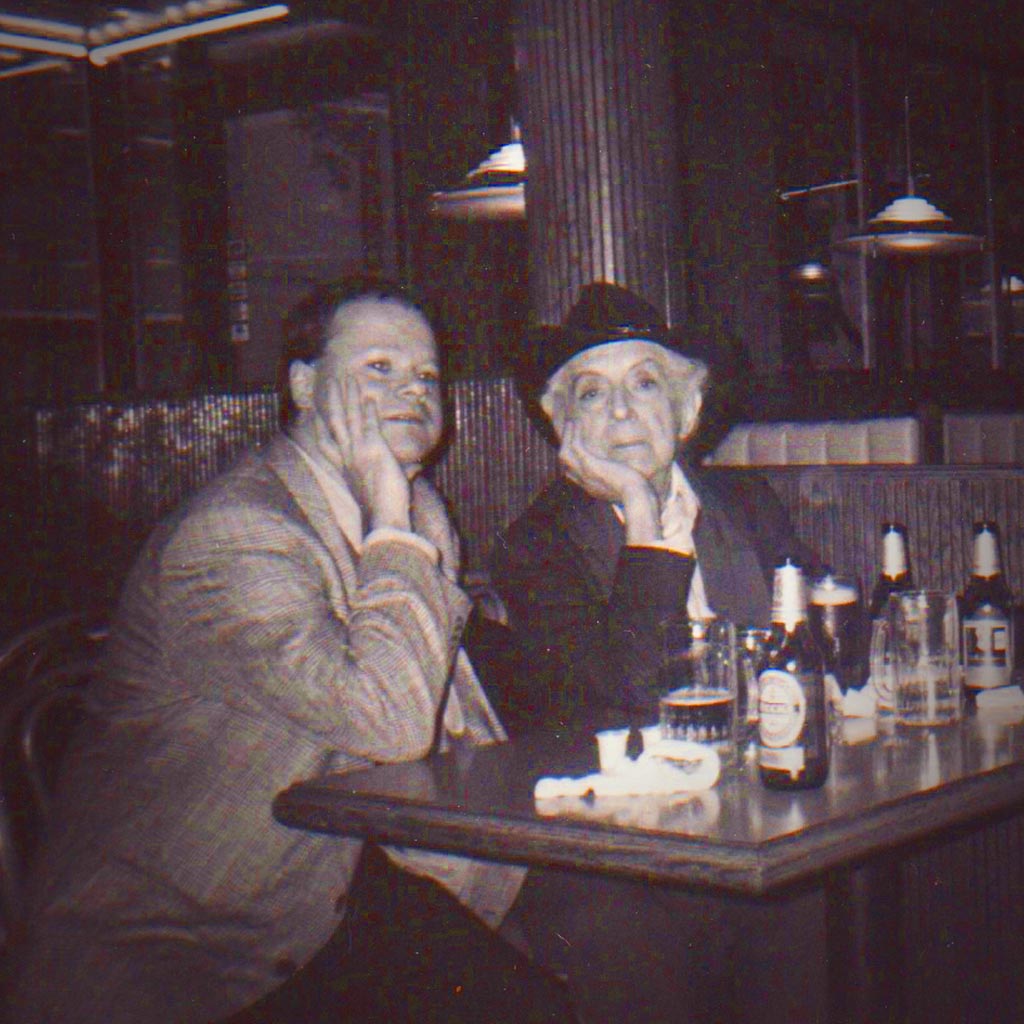

Lunch with Quentin Crisp
Quentin Crisp (25 December 1908 - 21 November 1999) was ‘one of the stately homos of England’. A great eccentric, inadvertent LGBT+ pioneer, and brilliant author, wit, and raconteur. Famously Crisp said, ‘I have nothing to offer the world but my availability’ pointing out that anyone could find his number in the New York telephone directory. Artist Martin Firrell tested this claim, calling Crisp and arranging to have lunch. The following account is from the artist's journal.
SUNDAY 2 NOVEMBER 1997. I flew to New York to have lunch with Quentin Crisp at his local diner, The Cooper Square Restaurant on the corner of E5th street and 2nd Avenue.
There is always something lovely about Manhattan of course, rumbling down Fifth Avenue in a yellow cab past the Flatiron Building, The Empire State in bright winter sunshine. Down to the Lower East Side and the diner, and Quentin.
The diner was plain from the outside - plate glass and dark wood - and plainer still on the inside - bare wooden tables and chairs. I arrived before Quentin, and two enormously tall men in white aprons (who seemed as capable of murder as cooking, washing up, or waiting tables) looked me up and down to ensure I was ‘alright’ to meet ‘Mr Crisp.
I must have passed the test because they showed me to a table to wait, and offered me beer. I had read
How To Become a Virgin
with Quentin's claim, 'All I have to offer the world is my availability.' He pointed out that he was listed in the Manhattan phone book under 'C'. I had looked up the number in the directory in my hotel room and he had answered with a theatrical 'Oh yes...'
And suddenly there he was, smaller than I had expected and very lovely, very beautifully got up with mauve hair under a wide-brimmed hat, light make up, wonderfully scented, wearing a pale silk shirt.
I had bought him a Liberty scarf as a gift from London and, sportingly, he put it on. At first I felt tongue-tied and shy, as if meeting Mickey Mouse in person or the Statue of Liberty for lunch. Quentin had loomed so large in my imagination as a beautiful idea for such a long time and now here he was as a man.
I do not remember what I ate, but Quentin always ate the same thing - a toasted cheese sandwich with a plate of mashed potatoes on the side and to drink: beer. He talked about New York as 'heaven on earth' and the old movie stars 'Miss Dietrich' and 'Miss Garbo', and I recognised some of the things he said from the books he had written.
I realised he was 'singing for his supper' or, more accurately, 'raconteuring for his lunch'. I felt delighted and then a little short-changed because he was not meeting me, but performing for me. I wondered if he, too, was nervous, and the performance was a way of overcoming his shyness.
The very tall men approached our table again, not as part of the service I realised, but to check on Quentin. As long as he was smiling they retreated back into the gloom of the diner but I have no doubt if he'd been unhappy with the conversation - or me - they would have thrown me out of the diner without ceremony.
At the time, controversy was surrounding Quentin because of comments he had made in an interview. He had, in effect, come out as transgender but the LGBT+ community knew and loved him as a gay icon. I asked him if it was true that he would have been happier if he could have transitioned and run a knitting shop in Harrogate.
For the first time over lunch, he stopped performing and looked me straight in the eye. He smiled and told me none of it was said for effect. He realised it had disappointed people but they have made him 'a gay icon', he had done nothing but live his life as truthfully as he could. Now he realised he was not homosexual at all but transgender.
In his last book,
The Last Word
, he confirmed these comments: 'If the operation had been available and cheap when I was young, say when I was twenty-five or twenty-six, I would have jumped at the chance. My life would have been much simpler as a result. I would have told nobody. Instead, I would have gone to live in a distant town and run a knitting wool shop and no one would ever have known my secret. I would have joined the real world and it would have been wonderful.'
I could see both sides of the argument. For the community he was a pioneer, living his own truth, and becoming acclaimed, as a gay man, for his courage, wit and imagination.
But I also saw the terrible cost of living as an 'outlaw' as he once described it. The relentlessness of that. The lack of peace.
I was young, in the early part of my career and eager for advice about how to ‘get on’. Quentin told me, ‘Say Yes to everything!’ And later on, in a telephone conversation a few weeks after our lunch: ‘Lean forward so that fate can catch sight of you.’
These words meant a great deal to me, and from that time I have tried, insofar as it is possible (and legal) to say yes to everything. I have tried to lean forward so that fate can catch sight of me, and the results have not been too shoddy.
To me, Quentin's overriding characteristic was being sure of being right in going on in his own way. Quentin would tell you that it was the only thing he was able to do. But I think there is more to it than that. I had the impression of deep courage and self-worth in spite of his comment in
The Last Word
that he was nobody and nothing.
As we ate, the sun went down behind the houses on the opposite side of the square. Long shadows in the afternoon and the sky unbelievably empty, bright, cold. Lunch with Quentin expanded my expectation of what life might offer and what I might be able to take up from it. Who couldn’t I meet? And also, how could you be deflected or disheartened by any obstruction you might meet?
I realised Quentin had lived so completely without reference to anything else, and had placed himself so completely outside. I saw the costs of this and the rewards. And by comparison it is so easy to see how much of our own decisions are based on regard for our position in relation to others. We are not independent. How little is independent. The terrible lesson of how difficult independence is to achieve and how far from reach it still is. Life is the thing you make. And nothing of it is, or can be, lived for someone else. As Quentin put it, the trick is to 'live your life as if no one else existed'.
When we parted in the street outside the diner, I kissed him on the cheek. His skin was so soft, lightly powered and scented with lavender. As I watched him walk slowly in the direction of his room where the dust never gets any worse, I realised with a start he had the form, not of a man, but of a wonderfully put together elderly lady. This was really who he had been all his life. We had all just been too slow in noticing.
Acknowledgement
Image: the artist with Quentin Crisp, Cooper Square Restaurant, NYC 1997. Courtesy of the artist.
View
The Last Word
Share this story

