We use the cookies _ga, _gat, _gid to collect anonymous data about how you use this site.
OK.

Bi-Pride
Inga Beale was appointed CEO of Lloyd’s of London in 2014, becoming the first woman to lead the insurance market and the first openly bisexual woman to top the Financial Times list of influential LGBT+ executives.
TRANSCRIPTInga Beale in conversation with public artist Martin Firrell, 22 June 2018.
MF: Can I ask you about being part of the LGBT+ community? Obviously you’ve done things that are very valuable: 1) being a woman and running things so other women can see it’s possible and 2) being an out bisexual person, which is a very personal and private thing made into a public thing. I think that kind of visibility is a benefit to all people, not necessarily just LGBT+ people. When people come into contact with someone who is living authentically, it frees them to be authentic. But that must have taken a degree of courage, mustn’t it?
IB: Yes, certainly when I came out officially at work. I was always out in my non-work life. In fact, before I went travelling, I had been in this long term relationship with a guy. When that broke up, I moved in with the woman I’d met at yoga. I remember bumping into my sister that day. I had been crying and I said, ‘Oh, it’s because Adrian and I are splitting up. Don’t tell mum and dad. I’m going to tell them tomorrow.’ I was going down to see them, and he was going off to see his parents. Anyway, my sister can’t keep her mouth shut and she’d obviously told my parents because I got a phone call from my father before I had even left home to see them. He said, ‘It’s absolutely fine. You can move in with a woman.There’s no problem with you being a lesbian.’
I thought, ‘I’m not a lesbian!’ I thought, ‘I’m just leaving my boyfriend and staying with the woman I’ve met at yoga.’ But because my father’s sister lived with a woman in a lesbian relationship for 50 years, that’s what he assumed. This was several years before I ever had a relationship with a woman. So you see, in a way, I was always out.
At home there was no problem but at work it was more of a challenge. I eventually came out because of one incident in particular. At the time of the hostile takeover bid, I had a wonderful PA. She was fabulous. We got on so well. After the hostile bid, we both left the firm. She took me out to dinner on a Saturday night because she felt sorry for me, thinking I was on my own. She didn’t know anything about the existence of my girlfriend. She asked me how I was coping with everything and I thought, ‘I’ve deceived this woman. This is absurd. Here I am on a Saturday night. My girlfriend should be here. This is the most ridiculous and bizarre situation.’ And from that day on I said, ‘I’m not doing this any more!’ That was actually the trigger point. My PA is now a dear friend, Sheila. It was that dinner with her. I remember the restaurant. I remember what we ate. I remember everything. And I said, ‘Right, no more!’
I went to the Zurich interview and I told the CEO upfront, ‘I’m with a woman, I hope that doesn’t cause a problem.’ And he said, ‘No.’
Why the hell had I been quiet about it for all these years? I mean, how ridiculous is that? So that was how I came out. When I came to Lloyd’s, I was approached to join the FT list of influential LGBT+ execs. I had only been here a few months and I said, ‘No, I can’t risk it’.
For the first year I wasn’t really talking openly in the media. I thought, ‘I can’t do it, I have to focus on my job, I have to get the respect of the market.’ It wasn’t until a year later that I felt able to say, ‘Okay, I’ll do it!’ But that took a lot of courage and we discussed within Lloyd’s whether or not I should put my name up for it.
MF: And was the mood supportive at Lloyd’s, Or very cautious?
IB: Well, my comms team were absolutely supportive. I was incredibly nervous about telling my chairman. He knew my sexual history but it was another thing entirely for it to appear in the FT and be read in Dubai and wherever, so we managed it as carefully as we could.
MF: Which is the right thing to do.
IB: But I did get hate mail. Letters cut out and glued to pieces of paper, and emails, and other letters from the US, telling me I didn’t deserve to be alive. Oh yes, I got all of that.
MF: I find that shocking.
IB: I haven’t had anything like that for the past two years but, yes, I got all of that.
MF: Did you ignore it all, send it all to the police?
IB: No, I ignored it. With hindsight, I think, ‘Why didn’t I keep it? I would have it all now.’ Again it’s my mechanism for coping. Get it all out. So if an abusive email comes in, I just delete it. Or I open a letter and I start reading it and if it’s abusive, I just throw it away. It’s my way. Moving on.
The question is, how can we get to this lovely equal state? I do think we are fighting against inequality all the time. I am always trying to think about equality. I just think, ‘Fair, equal. Fair and equal. Balance. Balanced.’ These are the words I try to hold in my head constantly. But we have so much talk that’s polarising.
We have a dinner club for LGBT+ senior leaders in insurance. We get together every now and then, and one of the topics of conversation at the last dinner related to shared parental leave. A firm had introduced equal parental leave and received feedback from the female members of staff that said, ‘Why are you helping the privileged man even more?’ There was this anger coming through from some of the women saying, ‘Men already have all the perks and benefits and now you’re giving them what we have!’ It’s more equal but they were resenting it. This is why it’s all so complicated isn’t it? It was just one example.
I thought. ‘No, we have to strive for this, we have to strive for equality.’ We have to try and take these gender-related words and ideas out of the equation. We have to support equal benefit for all regardless of gender. That’s what really struck me about this.
The answer as to how we achieve full equality is very elusive. It just seems overwhelming, too big an issue to address. But we have to try. We have to aim for it. Even in the context of Lloyd’s, I was constantly trying to challenge everything we were writing as policy or practice. Let’s make sure we’re just being absolutely equal. That’s our challenge especially when you’re starting from a very unequal place.
Acknowledgement
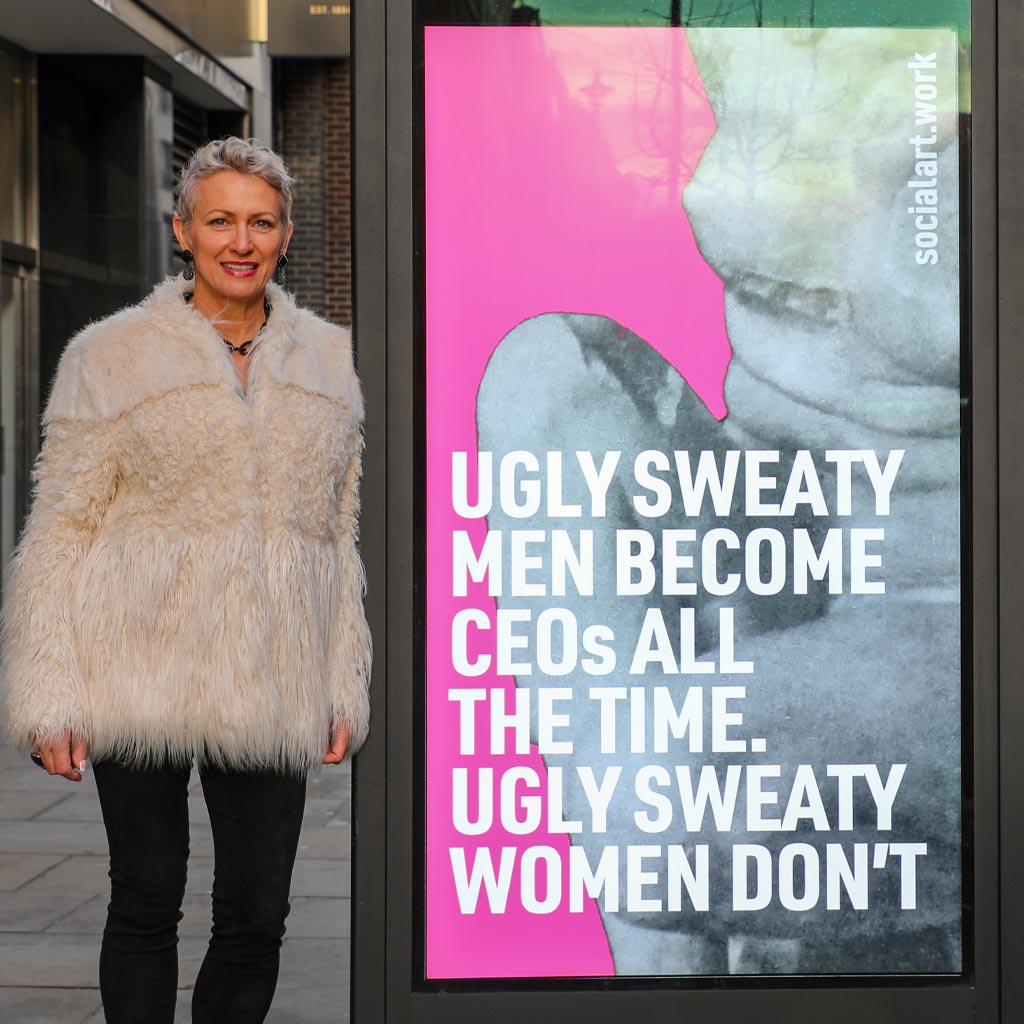
Image: Inga Beale with poster by Martin Firrell, co-created to mark 100 years of women's suffrage.
Share this story

